2014 Ford Escape 2.0 Ecoboost 0 60
Motor vehicle engine
| Ford EcoBoost engine | |
|---|---|
 | |
| Overview | |
| Manufacturer | Ford |
| Also called | TwinForce (obsolete) EcoBoost SCTi GTDi |
| Production | 2009–present |
| Layout | |
| Configuration | I3, I4 and 60° V6 |
| Displacement | V6 3.5: 3496 cc (213 CID) V6 2.7: 2694 cc (164 CID) I4 2.3: 2261 cc (138 CID) I4 2.0: 1999 cc (122 CID) I4 1.6: 1596 cc (97 CID) I4 1.5: 1500 cc (92 CID) I3 1.5: 1497 cc (91 CID) I3 1.0: 995 cc (60.44 CID) |
| Cylinder bore | V6 3.5: 3.64 in (92.5 mm) V6 2.7: 3.30 in (83 mm) I4 2.3: 3.45 in (87.55 mm)[1] I4 2.0: 3.4 in (87.5 mm)[1] I4 1.6: 3.1 in (79.0 mm)[2] I3 1.5: 3.31 in (84 mm) I3 1.0: 2.83 in (71.9 mm) |
| Piston stroke | V6 3.5: 3.41 in (86.6 mm) V6 2.7: 3.30 in (83 mm) I4 2.3: 3.7 in (94.0 mm) I4 2.0: 3.27 in (83.1 mm) I4 1.6: 3.2 in (81.4 mm) I3 1.5: 3.54 in (90 mm) I3 1.0: 3.2 in (82 mm) |
| Block material | V6 2.7: Compacted graphite iron I3 1.0: Cast iron All others: Aluminum |
| Head material | Aluminum |
| Valvetrain | DOHC with Direct Acting Mechanical Buckets (DAMB) Variable camshaft timing |
| Compression ratio | V6 3.5: 10.0:1(10.5:1 MY2017) I4 2.3: 9.5:1 I4 2.0: 10.0:1 I4 1.6: 10.0:1 I3 1.5: 9.7:1 |
| Combustion | |
| Turbocharger | V6: Dual Borg Warner K03 low inertia integrated turbo system I4 2.3: Honeywell Garrett Twin scroll MGT2260SZ (Mustang Ecoboost) I4 2.0: Borg Warner K03 low inertia integrated turbo system I4 1.6: Borg Warner KP39 low inertia turbo I3 1.5: Continental RAAX low-inertia turbocharger |
| Management | V6: Bosch [3] I4 2.0: Bosch MED17 with CAN-Bus and individual knock control I4 1.6: Bosch MED17 with CAN-Bus and individual cylinder knock control I3 1.5: Bosch MG1CS016 with CAN-Bus and individual cylinder knock control. FGEC software |
| Fuel type | Gasoline direct injection |
| Dimensions | |
| Dry weight | V6 3.5: 449 lbs (203 kg) V6 2.7: 440 lbs (200 kg) I4 2.0: 328 lbs(149 kg) I4 1.6: 251 lbs (114 kg) I3 1.0: 213 lbs (97 kg)[4] |
| Chronology | |
| Predecessor | Ford Duratec, Mazda MZI 35, Mazda GY |

EcoBoost is a series of turbocharged, direct-injection gasoline engines produced by Ford and originally co-developed by FEV Inc. EcoBoost engines are designed to deliver power and torque consistent with those of larger-displacement (cylinder volume), naturally aspirated engines, while achieving about 30% better fuel efficiency and 15% fewer greenhouse emissions, according to Ford. The manufacturer sees the EcoBoost technology as less costly and more versatile than further developing or expanding the use of hybrid and diesel engine technologies. EcoBoost engines are broadly available across the Ford vehicle lineup.[5]
Global production [edit]
EcoBoost gasoline direct-injection turbocharged engine technology adds 128 patents and patent applications to Ford's 4,618 active and thousands of pending US patents.[6] Some of the costs of US development and production were assisted by the $5.9 billion Advanced Technology Vehicles Manufacturing Loan Program by the Department of Energy.[7]
The V6 EcoBoost engines are being assembled at Cleveland Engine Plant No. 1 in Brook Park, Ohio.[8] The 2.0-liter I4 EcoBoost engines were produced at the Ford Valencia Plant in Spain in 2009.[9] The 1.6-liter I4 EcoBoost engines will be made at the Ford Bridgend Engine Plant in the United Kingdom.[9] The smaller 1000cc-displacement 3 cylinder EcoBoost engine is produced both at Ford Germany in Cologne and at Ford Romania in Craiova.[9]
By 2012, the company plans to produce 750,000 EcoBoost units annually in the US and 1.3 million globally in the world market. Ford expected over 90% of its global vehicle lineup (includes North America) to offer EcoBoost engine technology by 2013.[9] [10] From the engine's beginning to November 2012, 500,000 Ford EcoBoost vehicles have been sold.[11]
During Ford's ownership of Volvo (until 2010), it used the term PTDi (petrol turbocharged direct injection) for the 1.6 L I4 engine when introducing Volvo S60 concept[12] and for the 2.0 L I4 engine when introducing Volvo XC60.[13]
Safety issues [edit]
Ford has had to refund hundreds of customers worldwide because Ford EcoBoost engines in their vehicles have overheated and, in some cases, caused engine fires.[14] In 2015, a South African man died after becoming trapped in his Ford Kuga after its 1.6-litre EcoBoost engine burst into flames.[15] In 2017, Ford South Africa recalled all Kugas in the country for engine checks.[16] In 2020 a class action was launched in the USA alleging that Ford EcoBoost engines have an inherent defect that makes them dangerous.[17]
Engine family list [edit]
| Name | Family | Displacement | Year | Features |
|---|---|---|---|---|
| EcoBoost 1.0 | Fox | 999 cc (61.0 cu in) | 2012–present | DOHC I3 |
| Ti-VCT 1.1 | Fox | 1,084 cc (66.1 cu in) | 2017–present | DOHC I3 |
| EcoBoost 1.5 | Dragon | 1,497 cc (91.4 cu in) | 2018–present | DOHC I3 |
| EcoBoost 1.5 | Ford Sigma engine | 1,500 cc (92 cu in) | 2014–present | DOHC I4 |
| EcoBoost 1.6 | Ford Sigma engine | 1,596 cc (97.4 cu in) | 2010–present | DOHC I4 |
| EcoBoost 2.0 | Mazda L engine | 1,999 cc (122.0 cu in) | 2010–2014 | DOHC I4 |
| EcoBoost 2.0 twin scroll | Clean-sheet engine block[18] | 1,999 cc (122.0 cu in) | 2015–present | DOHC I4 |
| EcoBoost 2.3 | Clean-sheet engine block | 2,261 cc (138.0 cu in) | 2015–present | DOHC I4 |
| EcoBoost 2.7 | Nano | 2,694 cc (164.4 cu in) | 2015–present | DOHC V6 |
| EcoBoost 3.0 | Nano | 2,967 cc (181.1 cu in) | 2016–present | DOHC V6 |
| EcoBoost 3.5 | Cyclone | 3,496 cc (213.3 cu in) | 2010–present | DOHC V6 |
Inline three-cylinder [edit]
1.0 L Fox [edit]

Ford produces a 1.0 L turbocharged in-line three-cylinder engine for the EcoBoost family developed at Ford's Dunton Technical Centre in the UK. Production started in April 2012. The 1.0 is built initially in two versions: 74 kW (101 PS; 99 hp) and 88 to 92 kW (120 to 125 PS; 118 to 123 hp).
The more powerful version delivers a maximum of 170 N⋅m (130 lbf⋅ft) from 1,400 to 4,500 rpm and 200 N⋅m (150 lbf⋅ft) on overboost, which makes for a broad torque curve when compared to a naturally aspirated gasoline engine. A 140 PS (100 kW; 140 hp) version has also been released in the Fiesta Red Edition and Black Edition, as well as the Focus ST-Line, with 210 N⋅m (155 lb⋅ft) of torque. The engine block is cast iron, which offers, in addition to the required strength, up to 50% faster warm-up than aluminum, at the expense of additional weight.[19] [20]
To quell the natural vibrations of a three-cylinder design, unspecified efforts have been made in the flywheel design to ensure satisfactorily smooth running without the use of energy sapping balance shafts. The 1.0L EcoBoost GTDI engine uses an oil-bathed timing belt.[21]
The engine is packaged in an engine block with a footprint the size of an A4 sheet of paper.[22] With the introduction of the face-lifted 2013 Ford Fiesta, Ford introduced a naturally aspirated version of 1.0 Fox engine. The two versions produce 65 hp and 80 hp, and both engines use direct injection and Ti-VCT like the turbocharged versions. Start-stop technology is also available.
The engines are produced in Cologne (Germany), Craiova (Romania) and Chongqing (China). Production is expected to be 700,000–1,500,000 units per year. The engine is available in Ford Focus, the Ford Focus-based C-MAX and Grand C-MAX, Ford Fiesta, the Fiesta-based B-Max, and Transit Courier.[23] This version is also available in the second-generation Ford Ecosport manufactured and sold in Brazil, India, Thailand, and Russia, although in some markets, this vehicle comes with the 2.0 L EcoBoost engine.
The 1.0 L EcoBoost engine was introduced to the American market with the 2014 Ford Fiesta sedan and hatchback. It was announced at the 2012 Los Angeles Auto Show, when the Fiesta was introduced. The 123-hp version debuted in the North American market Focus in the 2015 model year. The engine accounted for less than 5 percent of Fiesta and Focus sales in the U.S., according to a 2017 report.[24] The 1.0 L engine was awarded the International Engine of Year Award 2016, making it the Best Engine Under 1.0 L for the fifth time in a row.[25] After the discontinuation of the Focus and Fiesta in North America, the 1.0 L is only available there in the EcoSport.
In 2017 Ford was again awarded International Engine of Year (for Engines Under 1.0 L) with an almost completely reconfigured version of the Ecoboost 1.0. Although thermodynamically similar to the old Ecoboost 1.0, the new engine features cylinder deactivation under low-load conditions. A new dual-mass flywheel and a vibration-damping clutch disc (in manual-transmission vehicles) help neutralise engine oscillations when running on two cylinders.[26] Production started in 2018.
In 2019, Ford launched an mHEV version of the 1.0 EcoBoost engine first fitted to the Puma SUV, which uses a belt-driven integrated starter/generator-motor (BiSG); which is in essence a starter motor, alternator, and propulsion motor in one. Fundamentally, the engine is identical to the 2018–present 1.0 EcoBoost, but features the electric starter/generator. The motor itself is not used to propel the vehicle on its own, and is mainly used to increase efficiency by reducing engine load, provide extra power during acceleration, and to reduce the perceived 'turbo-lag' at certain engine speeds while accelerating. The starter/generator makes use of a 48-volt battery system in the car, although vehicles fitted with these engines are not plug-in hybrids or full hybrids. Further developments introduced include a more comprehensive 'start-stop' functionality, which was previously available but did not cut the engine off until the vehicle was completely stopped. The new engines can turn off while the car decelerates, at a maximum speed of about 15 mph. The new, electrified engines are only available with a manual transmission and are available in either 125 bhp or 154 bhp outputs.
Applications [edit]
85 PS (63 kW; 84 hp)
- 2018–2019 Ford Focus
100 PS (74 kW; 99 hp)
- 2012–present Ford Focus
- 2012–present Ford C-Max
- 2012–present Ford B-Max
- 2013–present Ford Fiesta
- 2013–present Ford Ecosport
125 PS (92 kW; 123 hp)
- 2012–present Ford Focus
- 2012–present Ford C-Max
- 2012–present Ford B-Max
- 2013–present Ford Fiesta
- 2013–present Ford EcoSport
- 2013–present Ford Mondeo
- 2014–present Ford Transit Courier
140 PS (100 kW; 140 hp)
- 2014–present Ford Fiesta
- 2014–2018 Ford Focus
155 PS (114 kW; 153 hp) (EcoBoost Hybrid (MHEV)) & 125 PS (92 kW; 123 hp) (EcoBoost Hybrid (MHEV))
- 2019–present Ford Puma mHEV
- 2020–present Ford Fiesta mHEV
- 2020–present Ford Focus mHEV
1.1 L Duratec Ti-VCT [edit]
Applications [edit]
70 PS (51 kW; 69 hp)
- 2017–present Ford Fiesta 1.1 Ti-VCT (70)
85 PS (63 kW; 84 hp)
- 2017–present Ford Fiesta 1.1 Ti-VCT (85)
1.5 L Dragon [edit]
On 24 February 2017, as part of the unveiling of the seventh generation (Mk8 - UK) derived Fiesta ST, Ford announced an all-new aluminum inline 3-cylinder 1.5 L EcoBoost engine with cylinder deactivation technology.[27] The version of this engine announced for the Fiesta ST produces 200 PS (150 kW; 200 hp) at 6,000 rpm and delivers 290 N⋅m (210 lbf⋅ft) of torque from 1,600 to 4,000 rpm.[28]
The engine is based on an expansion of the 1.0 EcoBoost, taking the capacity per cylinder up to 500cc which Ford consider is likely to be the maximum for optimum thermal efficiency.[29] The engine is an all-aluminum design with integrated exhaust manifold, low inertia mixed flow turbocharger and combines both port fuel injection and direct fuel injection.
The engine will be available with cylinder deactivation technology, implemented by stopping fuel delivery and valve operation for one of the engine's cylinders in conditions where full capacity is not needed.
Applications [edit]
150 PS (110 kW; 150 hp)
- 2018–present Ford Focus
182 PS (134 kW; 180 hp)
- 2018–present Ford Focus
- 2020–present Ford Escape
- 2021 - Ford Bronco Sport (181 hp)
200 PS (150 kW; 200 hp)
- 2018–present Ford Fiesta ST
- 2021–present Ford Puma ST
Inline four-cylinder [edit]
Four versions of EcoBoost I4 engines are in production. A 1.5 L downsized version of the 1.6 L, the 1.6 L which replaces larger-displacement, naturally aspirated I4 engines in Ford vehicles, a 2.0 L which replaces small-displacement, naturally aspirated V6 engines, and a 2.3 L used in high-performance applications. All four engines are turbocharged and direct injected. The production engine family was officially announced at the 2009 Frankfurt Motor Show.[30]
1.5 L [edit]
A 1.5 L version of the EcoBoost engine family was first unveiled in the 2014 Ford Fusion as a downsized version of the 1.6 L EcoBoost engine.[31] The downsized displacement is a result of Chinese vehicle tax regulations which tax vehicles with engine displacements of 1.5 L or less at lower rates. The 1.5 L EcoBoost adds new technology compared to the 1.6 L on which it is based, including an integrated exhaust manifold and a computer-controlled water pump clutch to decrease warm up time. In the 2015 Fusion, the engine produces 181 hp (135 kW; 184 PS) and 185 lb ft .
Applications [edit]
184 PS (135 kW; 181 hp)
- 2014 - 2020 Ford Fusion
- 2015 - Ford Focus
181 PS (133 kW; 179 hp)
- 2017–2019 Ford Escape
162 PS (119 kW; 160 hp)
- 2017–2019 Landwind X7
160 PS (118 kW; 158 hp)
- 2015 - Ford Mondeo
150 PS (110 kW; 148 hp)
- 2015 - Ford Focus
- 2015 - Ford C-Max
1.6 L [edit]


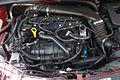
The 1.6-litre version was first unveiled in the 2009 Lincoln C concept. The engine is rated at 197 hp (147 kW; 200 PS) and 207 lb⋅ft (280.7 N⋅m).[32] This was also installed in many Volvos during the years of Ford's ownership of that company; Volvo badged the engine B4164T# (with # being different number for different iterations).
The European market version of the 1.6 L provides 150 hp (112 kW; 152 PS), although a 160 hp (119 kW; 162 PS) version is used in the Ford Mondeo.
The 1.6 L EcoBoost engine is raced in the British Formula Ford Championship. The units have replaced the original N/A 1.6 L Duratec units, which in turn replaced the 1.8 L Zetec-engined cars. The engine has also been used for the past few seasons in the WRC in the Ford Fiesta.
The 1.6 L EcoBoost engine is also produced at the Ford Bridgend Engine Plant in Bridgend, Wales.
Safety and recalls [edit]
In 2013, Ford has recalled certain Ford Escapes equipped with this engine due to the potential for them to catch fire after overheating.[33]
In 2017, Ford recalled over 360,000 Ford Escape, Ford Fiesta ST, Ford Fusion, Ford Transit Connect, Ford Focus and C-Max hybrid with 1.6 ecoboost engines because of a risk of engine fires caused by a "lack of coolant circulation". There were 29 fires in the U.S. and Canada reported to Ford. The recall partly contributed to a charge of US$300 million by Ford.[34] [35]
Specifications [edit]
Type-turbocharged, direct gasoline-injected inline four-cylinder engine with twin independent variable-camshaft timing
Displacement-1,596 cc (1.6 L; 97 cu in)
| More details |
|---|
| Type Turbocharged, direct gasoline-injected inline four-cylinder engine with twin independent variable-camshaft timing |
Applications [edit]
120 PS (88 kW; 118 hp)
- 2013— Volvo V40
150 PS (110 kW; 148 hp)
- 2010— Ford C-MAX
- 2010— Ford Focus
- 2010—2018 Volvo S60
- 2010—2018 Volvo V60
- 2012— Volvo V40
160 PS (118 kW; 158 hp)
- 2011— Ford Mondeo
- 2011— Ford S-Max
- 2011— Ford Galaxy
180 PS (132 kW; 178 hp)
- 2010 — Ford Focus
- 2013—2016 Ford Escape
- 2014—2016 Ford Transit Connect
185 PS (136 kW; 182 hp)
- 2010— Ford C-MAX
- 2010—2018 Volvo S60
- 2010—2018 Volvo V60
- 2011— Ford Focus
- 2011—2016 Volvo V70
- 2011—2016 Volvo S80
- 2012— Volvo V40
- 2013— Ford Fiesta ST (all)
- 2013−2014 Ford Fusion
200 PS (147 kW; 197 hp)
- 2016—2017 Ford Fiesta ST200
Rally Car engine
- Ford Fiesta R5
- Ford Fiesta Rally2
- Ford Fiesta RS WRC
- Ford Fiesta WRC
2.0 L (2010–2015) [edit]
-

2.0L EcoBoost demo engine and the 2011 NAIAS
-

2.0L EcoBoost demo engine at the 2011 NAIAS. Note the exhaust manifold, not present on production North American engines
-

Another angle of the 2011 NAIAS demo engine, again showing the Euro-spec exhaust manifold
A 2.0 L version was first seen in the 2008 Ford Explorer America concept.[36] The engine was rated at 275 hp (205 kW; 279 PS) and 280 lb⋅ft (380 N⋅m).
It is the first EcoBoost engine to include twin independent variable cam timing (Ti-VCT), with advertised 10–20% better fuel economy while maintaining the performance of 3.0 L V6s.[37] [38]
This engine is derived from the 2.0 L Mazda L engine block used by Ford in the North American Focus MK3, but equipped with unique heads, fuel injection system, and Ford's Ti-VCT. It should not be confused with the Mazda 2.3 DISI Turbo, which also features direct injection along with turbocharging, but shares little else aside from the same engine block.
The 2.0 L EcoBoost engine used in North American vehicles is now produced at the Cleveland Engine Plant in Brook Park, Ohio.
Specifications [edit]
Type- turbocharged, direct gasoline-injected inline four-cylinder engine with Ti-VCT
Displacement-1,999 cc (2 L; 122 cu in)
| More details |
|---|
| Type Turbocharged, direct gasoline-injected inline four-cylinder engine with Ti-VCT |
Applications [edit]
Although not listed some 2.0 EcoBoost engines have a different block design including alternate weaker deck design and cooling ports missing. When installed in Volvos, these engines are called B4204T6 and T7.
It should also be noted that North American-spec and European-spec engines have different cylinder heads: North American market vehicles use a cylinder head with an integrated exhaust manifold, while European-spec vehicles use a cylinder head with individual exhaust ports and a conventional exhaust manifold.
- 203 PS (149 kW; 200 hp) at 5500 rpm, 221 lb⋅ft (300 N⋅m) at 1750-4500 rpm[39]
- 2010– Ford S-MAX
- 2010– Ford Galaxy
- 2010– Ford Mondeo
- 2010–2011 Volvo S60 2.0T
- 2010–2011 Volvo V60 2.0T
- 2010–2011 Volvo V70 2.0T
- 243 PS (179 kW; 240 hp) at 5500 rpm, 270 lb⋅ft (366 N⋅m) at 1900–3500 rpm[40] (Note: Torque figures are not uniform for all of the following vehicles)
- 2010– Ford Mondeo[41]
- 2010–2013 Volvo S60 T5
- 2010–2013 Volvo V60 T5
- 2012–2017 Volvo XC60 T5
- 2011–2015 Ford Explorer
- 2011–2014 Ford Edge
- 2011– 2017 Range Rover Evoque[42]
- 2011– Ford S-MAX
- 2012–2016 Ford Falcon[43]
- 2013–2015 Ford Escape / Ford Kuga
- 2013–2015 Land Rover Freelander 2
- 2013–2016 Ford Fusion
- 2013–2017 Ford Taurus[44] [45] [46]
- 2013–2015 Lincoln MKZ
- 2015–2017 Land Rover Discovery Sport
- 2015–2018 Lincoln MKC
- 255 PS (188 kW; 252 hp) at 5500 rpm, 270 lb⋅ft (366 N⋅m) at 2000–4500 rpm[47]
- 2012–2018 Ford Focus ST
- 290 PS (213 kW; 286 hp) at 5500 rpm, 310 lb⋅ft (420 N⋅m) at 1900–3500
- 2008–2017 VUHL 05
- 305 PS (224 kW; 301 hp) at 5500 rpm, 270 lb⋅ft (366 N·m) at 2500 rpm, Ford-RPE (Radical Performance Engines)
- 2011– Radical SR3 SL[48]
2.0 L "Twin-scroll" (2015–) [edit]
 | This section needs expansion. You can help by adding to it. (June 2014) |
A redesigned 2.0 L EcoBoost four-cylinder was introduced with the second-generation Ford Edge, followed by the 2017 Ford Escape in spring 2016.[49] It features a higher compression ratio than its predecessor (10.1:1 vs 9.3:1) along with twin-scroll turbocharger and fuel and oil systems upgrades.[50] This new engine will deliver more low-end torque than its predecessor and all-wheel drive will be available in this configuration. It is also expected to tow 3,500 lb (1,600 kg) in the redesigned Edge and 2017 Escape.
Applications [edit]
- Approx. 245 hp (183 kW; 248 PS), 275 lb⋅ft (373 N⋅m)
- 2015–2018 Ford Edge
- 2015– Ford Everest
- 2015– Zenos E10 S[51]
- 2016– Ford Tourneo
- 2016– Ford Escape / Ford Kuga
- 2017–2020 Ford Fusion
- 2021– Ford Bronco Sport
- 2016– Lincoln MKZ
- 2019 Lincoln MKC
- 250 hp (186 kW; 253 PS), 280 lb⋅ft (380 N⋅m)
- 2019– Ford Edge
- 2019– Lincoln Nautilus[52]
- 2020– Lincoln Corsair
- 2022– Ford Maverick
2.3 L [edit]
The 2.3L version of the EcoBoost engine debuted in the 2015 Ford Mustang and also the Lincoln MKC crossover and has been implemented in many Ford and Lincoln vehicles with various outputs.
The 2.3 L EcoBoost engine is produced with the 2.0 L EcoBoost at the Valencia Engine Plant in Valencia, Spain. In March 2015 Ford announced the official production start of the all-new twin-scroll 2.0-liter and 2.3-liter EcoBoost engines for North America at its Cleveland Engine Plant in Ohio.[53]
Applications [edit]
- 269 hp (201 kW; 273 PS) at 5500 rpm, 310 lb⋅ft (420 N⋅m) at 3000 rpm
- 2019– Ford Ranger
- 2020– Ford Everest[54]
- 280 hp (209 kW; 284 PS) at 5600 rpm, 310 lb⋅ft (420 N⋅m) at 3000 rpm
- 2016–2019 Ford Explorer
- 285–295 hp (213–220 kW; 289–299 PS) at 5500 rpm, 305–310 lb⋅ft (414–420 N⋅m) at 2750 rpm
- 2015–2019 Lincoln MKC
- 2020– Lincoln Corsair
- 300 hp (224 kW; 304 PS) at 5500 rpm, 310 lb⋅ft (420 N⋅m) at 3500 rpm
- 2020– Ford Explorer
- 2021– Ford Bronco (300-hp, 325-lbft)
- 310 hp (231 kW; 314 PS) at 5500 rpm, 320–350 lb⋅ft (434–475 N⋅m) at 3000 rpm
- 2015– Ford Mustang EcoBoost
- 345 hp (257 kW; 350 PS) at 6000 rpm, 350 lb⋅ft (475 N⋅m) at 3200 rpm
- 2016–2018 Ford Focus RS[55] [56] [57]
- 2016- Zenos E10 R[58]
- 2017- Elemental RP1[59]
- 325–405 hp (242–302 kW; 330–411 PS) at 6000 rpm, 317–369 lb⋅ft (430–500 N⋅m) at 3200 rpm
- 2016– VUHL 05 RR[60] [61] [62]
- 395 hp (295 kW; 400 PS) at 6200 rpm, 369 lb⋅ft (500 N⋅m) at 3000-3500 rpm
- 2017- Dallara Stradale[63]
- 276 hp (206 kW; 280 PS) at 5500 rpm, 310 lb⋅ft (420 N⋅m) at 3000–4000 rpm
- 2019– Ford Focus ST (2020)
V-type six-cylinder [edit]
2.7 L Nano (first generation) [edit]
Introduced with the 2015 Ford F-150 is a twin-turbo 2.7 L V6 EcoBoost engine. It delivers 325 hp (242 kW) and 375 lb⋅ft (508 N⋅m).[64] The engine is built at the Lima Ford Engine Plant.[65] Ford has invested US$500 million in the Lima plant for the new engine. Ford also states that the new engine will bring 300 jobs to Allen County, Ohio,[66] but transfers from other plants make the actual number hard to pin down. A 335-hp version is to be an option on the 2017 Lincoln Continental. Being a next-generation design, it uses a two piece block design. Compacted graphite iron, a material Ford uses in its 6.7 L PowerStroke diesel engine, is used for the upper cylinder section with aluminum used for the lower stiffening section of the block.[67]
Applications [edit]
- 325 hp (242 kW) at 5750 rpm, 375 lb⋅ft (508 N⋅m) at 3000 rpm
- 2015–2017 Ford F-150
- 335 hp (250 kW) at 5500 rpm, 380 lb⋅ft (515 N⋅m) at 3000 rpm[68]
- 2016–2018 Lincoln MKX
- 2017–2020 Lincoln Continental
- 335 hp (250 kW) at 5500 rpm, 380 lb⋅ft (515 N⋅m) at 3250 rpm
- 2019– Lincoln Nautilus
- 315 hp (235 kW) at 4750 rpm, 350 lb⋅ft (475 N⋅m) at 2750 rpm
- 2015–2018 Ford Edge Sport
- 335 hp (250 kW) at 5000 rpm, 380 lb⋅ft (515 N⋅m) at 3000 rpm[69]
- 2019– Ford Edge ST
- 325 hp (242 kW) at 5500 rpm, 380 lb⋅ft (515 N⋅m) at 3500 rpm
- 2017–2019 Ford Fusion Sport
2.7 L Nano (second generation) [edit]
The second generation 2.7L EcoBoost V6 is being introduced with the 2018 Ford F-150 and is mated to a 10-speed transmission that debuted the year prior. It produces an additional 25 lb⋅ft (34 N⋅m) of torque over the first generation. The engine uses a compacted-graphite iron (CGI) block, which is both high strength and lightweight.
It boasts a number of changes from the first generation, with many carrying over from the second generation 3.5L EcoBoost engine that arrived a year earlier in the F-150. The most prominent change being the addition of port fuel injection, while keeping the direct injection system. It also has reduced internal friction to improve power and fuel economy, and new exhaust gas recirculation system.[70] The specific output of the engine is now 121 hp/L, versus the 395-hp Ford Coyote 5.0L naturally aspirated V-8 which has a specific output of only 78 hp/L. The peak torque matches the 5.0L V-8, albeit at a lower 2,750 rpm vs. 4,500 rpm for the V-8.
Additional changes include a new lightweight cam to save weight, dual-chain cam drive system that is stronger and reduces parasitic friction loss, a new electrically actuated wastegate that provides more accurate turbo boost control, a high-pressure exhaust gas recirculation system, and a variable-displacement oil pump that is electronically controlled to modulate oil flow to further reduce parasitic losses. [71]
Applications [edit]
- 325 hp (242 kW) at 5000 rpm, 400 lb⋅ft (542 N⋅m) at 2750 rpm
- 2018– Ford F-150
- 310 hp (231 kW) and 400 lb⋅ft (542 N⋅m)
- 2021– Ford Bronco
3.0 L Nano [edit]
A 3 L V6 twin-turbocharged gasoline direct-injection engine, derived from the 2.7 L EcoBoost, was released in 2016 that produces between 350 and 400 horsepower. Currently, the 3.0 L is mostly exclusive to the Lincoln line-up to include the MKZ (which replaces the 3.7 L Ti-VCT Cyclone V6 engine the previous year), the Continental, and the upcoming 2020 Aviator and Ford Explorer. The engine offers Dynamic Torque Vectoring with available AWD in selected models. The 3.0-liter version of the engine was created by increasing the 2.7-liter's cylinder bore in the CGI-block from 83.0 millimeters to 85.3, and by lengthening piston stroke by 3.0 millimeters (to 86.0).[72]
Applications [edit]
- 350 hp (261 kW) at 5500 rpm, 400 lb⋅ft (542 N⋅m) at 2750 rpm (Front-wheel drive only)
- 2017– 2020 Lincoln MKZ
- 400 hp (298 kW) at 5750 rpm, 400 lb⋅ft (542 N⋅m) at 2750 rpm (All-wheel drive only)
- 2017– 2020 Lincoln Continental
- 2017– 2020 Lincoln MKZ
- 365 hp (272 kW) at 5500 rpm, 380 lb⋅ft (515 N⋅m) at 3500 rpm
- 2020 Ford Explorer Platinum
- 400 hp (298 kW) at 5500 rpm, 415 lb⋅ft (563 N⋅m) at 3500 rpm
- 2020– Ford Explorer ST
- 2020– Lincoln Aviator
- 494 hp (368 kW) total, with added electric engines at 5500 rpm, 630 lb⋅ft (854 N⋅m)total, with added electric engines at 3000 rpm
- 2020– Lincoln Aviator plug-in Hybrid
3.5 L (first generation) [edit]
The first Ford vehicle to feature this engine was the 2007 Lincoln MKR concept vehicle under the name TwinForce.[73] The engine was designed to deliver power and torque output equivalent to a typical 6.0 L or larger-displacement V8 while achieving at least 15% better fuel efficiency and reduced greenhouse emissions. In the MKR, the concept TwinForce engine was rated at 415 hp (309 kW) and 400 lb⋅ft (542 N⋅m) of torque, as well as run on E85 fuel.[74] When the same prototype engine reappeared in the Lincoln MKT concept in 2008 North American International Auto Show, the name was changed to EcoBoost. Official EcoBoost production began on May 19, 2009 at Cleveland Engine Plant No. 1.
The production engines use the Duratec 35 V6 engine block. The fuel charging and delivery systems can attain high fuel pressures up to 2150 psi, necessary for efficient operation of the direct fuel injection system. The F-series EcoBoost 3.5L V6 uses two BorgWarner K03 turbochargers which can spin up to 170,000 rpm and provide up to 15 psi of boost. The transverse EcoBoost 3.5L V6 uses two Garrett GT1549L turbochargers and provides up to 11 psi of boost. The turbos are set up in a twin-turbo configuration. The engine can consume up to 25% more air over the naturally aspirated counterpart. Through the use of direct injection, the engine needs only regular-grade gasoline to run. The EcoBoost V6 was first available as an engine option for 2010 Lincoln MKS, followed by 2010 Ford Flex, 2010 Ford Taurus SHO, and 2010 Lincoln MKT.[75] The fuel-charging and -delivery systems were co-developed with Robert Bosch GmbH.[76]
In 2009, Ford modified an experimental 3.5 L V6 EcoBoost engine with both E85 direct injection and gasoline indirect fuel injection, which achieved a brake mean effective pressure of 395 psi (27 bar), which translates to roughly 553 pound-feet (750 N⋅m) of torque and 316 horsepower (236 kW) at 3000 rpm (flat torque curve from 1500–3000 rpm).[77]
Applications [edit]
- 310 hp (231 kW) at 5500 rpm, 400 lb⋅ft (542 N⋅m) at 2250 rpm
- 2015– Ford Transit
- 355 hp (265 kW) at 5700 rpm, 350 lb⋅ft (475 N⋅m) at 3500 rpm
- 2010–2012 Ford Flex
- 2010–2012 Lincoln MKS
- 2010–2012 Lincoln MKT
- 365 hp (272 kW) at 5500 rpm, 350 lb⋅ft (475 N⋅m) at 1500-5000 rpm
- 2010–2019 Ford Taurus SHO[78]
- 2013–2019 Police Interceptor Sedan
- 2013–2016 Lincoln MKS[79]
- 2013–2019 Lincoln MKT[80]
- 365 hp (272 kW) at 5500 rpm, 350 lb⋅ft (475 N⋅m) at 3500 rpm
- 2013–2019 Ford Explorer Sport[81]
- 2016–2019 Ford Explorer Platinum
- 2013–2019 Ford Flex[82]
- 2014–2019 Ford Police Interceptor Utility
- 365 hp (272 kW) at 5000 rpm, 420 lb⋅ft (569 N⋅m) at 2500 rpm
- 2011–2016 Ford F-150[83] [84] [85]
- 365 hp (272 kW) at 5000 rpm, 420 lb⋅ft (569 N⋅m) at 2250 rpm
- 2015–2017 Ford Expedition/Expedition EL
- 380 hp (283 kW) at 5250 rpm, 460 lb⋅ft (624 N⋅m) at 2750 rpm
- 2015–2017 Lincoln Navigator/Navigator L


3.5 L (D35; second generation) [edit]
The second generation 3.5L EcoBoost V6 (codename D35) was introduced for the 2017 Ford GT, revealed at the 2015 Detroit Auto Show in January, as well as the 2017 F-150, 2018 Expedition and 2018 Navigator.[86] It produces up to 647 hp (482 kW) [87] paired with a seven-speed semiautomatic transmission. This engine replaces the 5.4 L supercharged modular V8 from the last generation Ford GT. The GT was on an 11-year hiatus and returned in 2016 for the 2017 model year.
Also announced at the 2015 Detroit Auto Show was the 2017 Ford F-150 SVT Raptor, which is powered by an all-new 3.5 L twin-turbocharged EcoBoost V6.[88] This new engine will produce 450 horsepower in the Raptor, up from the previous 6.2-L V8's 411.
The same second-generation 3.5L V6 is replacing the first-generation engine in the 2017 F-150 line-up. It will be standard on the F-150 Limited and remain an optional upgrade for other trim levels. Paired with the second-generation 3.5L EcoBoost V6 is the new 10R80 10-speed automatic transmission that was co-designed with GM. This new transmission will be outfitted on all second-generation 3.5L V6 EcoBoost F-150s. The 10-speed will be exclusive to the 3.5L EcoBoost engine in F-150s for the 2017 model year.
Changes from previous generation [edit]
The most prominent change is the addition of port fuel injection, while keeping the direct injectors. The port fuel injection was partly added due to the fuel output needs on the 3.5L HO Raptor engine, but also has several benefits for the 3.5L EcoBoost. It will prevent buildup on the intake valves and keep them clean due to fuel passing over the valves. Under certain engine conditions such as low rpm and low loads the high-pressure fuel pump and direct injection system will turn off and the engine will only use the port fuel injection, reducing efficiency losses due to the HPFP. Both systems will operate at cold start, which will reduce emissions that direct injection suffers due to cold cylinder walls and lower fuel atomization.
Turbocharger changes include electronically actuated wastegates, turbine wheels now made with lighter Mar-M-247 super-alloy increasing responsiveness, and the same 51 mm turbine wheels but with sharper vane angles allowing between 2.5 psi (0.17 bar) and 16 psi (1.1 bar) higher boost. The turbochargers continue to be supplied by Borg Warner.
The cam drive system changed from a single primary chain to a stronger two primary chain system with separate chains driving each cylinder bank. In addition to dual primary chains, the side plates on the chains were also thickened. The cam chain drive sprocket on the crankshaft is a double gear arrangement to drive the two primary chains. These two changes were done to improve the harmonics, and are also stronger to help minimize the chain stretch that can occur over time on the 1st generation 3.5L EcoBoost.
The camshafts were made hollow for weight savings, along with the addition of a roller-finger follower valvetrain. The compression ratio was increased from 10.0:1 to 10.5:1 (except on the 3.5L EcoBoost HO for the Raptor, which remains at 10.0:1).
The camshaft VCT (phaser) design was also changed to improve reliability and reduce the development of a tapping noise over time.
Ford uses a single piston cooling jet per cylinder, but the oil volume was increased. The underside of the pistons were also redesigned to better transfer heat into the oil.
The engine also features auto start/stop, which decreases emissions during city driving by shutting the engine off in extended idling periods.
The engines are also 4 lb (1.8 kg) lighter than the previous 3.5L EcoBoost. [89]
Applications [edit]
- 375 hp (280 kW) at 5000 rpm, 470 lb⋅ft (637 N⋅m) at 2250-3500 rpm
- 2017–2020 Ford F-150
- 2018– Ford Expedition
- 400 hp (298 kW) at 5000 rpm, 480 lb⋅ft (651 N⋅m) at 3250 rpm
- 2018– Ford Expedition Platinum Series
- 400 hp (298 kW) at 6000 rpm, 500 lb⋅ft (678 N⋅m) at 3100 rpm
- 2021– Ford F-150
- 430 hp (321 kW) at 6000 rpm, 570 lb⋅ft (773 N⋅m) at 3000 rpm
- 2021– Ford F-150 PowerBoost Hybrid
- 450 hp (336 kW) at 5000 rpm, 510 lb⋅ft (691 N⋅m) at 3500 rpm
- 2017– Ford F-150 Raptor
- 2019–2020 Ford F-150 Limited
- 2018– Lincoln Navigator
- 647 hp (482 kW) at 6250 rpm, 550 lb⋅ft (746 N⋅m) at 5900 rpm
- 2017–2019 Ford GT
- 660 hp (492 kW) at 6250 rpm, 550 lb⋅ft (746 N⋅m) at 5900 rpm
- 2020– Ford GT[90]
See also [edit]
- Ford Duratec engine
- List of Ford engines
- Ford PowerShift transmission
References [edit]
- ^ "2015 Ford Mustang – USA Technical Specifications" (PDF). Ford.com. Ford Motor Company. Retrieved March 19, 2017.
- ^ "Ford of Europe Press Kit – All-new Ford Focus". =All-newfordfocus.fordmedia.eu. January 2011. Retrieved January 24, 2012.
- ^ English, Andrew (August 10, 2013). "A Look at the Record-setting EcoBoost Sportscar Engine". Enginelabs. Retrieved January 25, 2017.
- ^ English, Andrew (February 8, 2012). "Ford Focus 1.0-litre EcoBoost review". Auto Express. Retrieved July 27, 2016.
- ^ "What Is Ford EcoBoost? | Learn What Goes Into Ecoboost Performance". Ford.com . Retrieved November 16, 2017.
- ^ "EcoBoost contributes 980 new US patents, continues Ford tradition of patent quality". Ford.com. October 2, 2009. Retrieved November 24, 2009.
- ^ Balaskovitz, Andy (May 21, 2014). "Fuel-efficiency loan program looking beyond the Big Three". Midwest Energy News . Retrieved November 27, 2016.
- ^ Kroll, Kathie (May 18, 2009). "Ford Cleveland Engine Plant No. 1 in Brook Park reopens after about 2 years". Cleveland.com . Retrieved November 24, 2009.
- ^ a b c d "New high efficiency four-cylinder Ford EcoBoost engine family debuts at Frankfurt". Media.Ford.com. September 15, 2009. Retrieved November 24, 2009.
- ^ "Pump it Up: EcoBoost Twin Turbos Pack Power to Give V-6 Engines V-8 Performance Feel". Ford Media. Ford Motor Company. January 11, 2009.
- ^ "500,000 Ford EcoBoost Sold". Ford Media. ScoopCar. November 21, 2012. Archived from the original on February 25, 2013. Retrieved November 21, 2012.
- ^ "2010 Volvo S60 Concept Offers Look at EcoBoosted 1.6-liter Engine". KBB Green. Kelley Blue Book. Archived from the original on January 11, 2013. Retrieved July 19, 2009.
- ^ "Volvo V70 and S80, Now with 2.0 GTDi". autoevolution.com . Retrieved March 18, 2011.
- ^ "Ford to refund 'engine fail' EcoBoost customers". BBC NEWS. October 1, 2018.
- ^ "Ford has only given us excuses - relative of Kuga victim killed in fire". www.news24.com. January 16, 2017.
- ^ "Ford recalls all Kugas in South Africa due to fires". www.autocar.co.uk. January 16, 2017.
- ^ "Ford EcoBoost Has a Dangerous Engine Defect, Owners Say". www.topclassactions.com. December 7, 2020.
- ^ "Ford to replace 2.0-liter EcoBoost engine after just 4 model years". Autonews.com. June 24, 2014. Retrieved March 19, 2019.
- ^ Martin, Jack (June 6, 2011). "Ford produces the smallest motor in its history – three-cylinder 1.0-Litre EcoBoost". gizmag.com.
- ^ Shunk, Chris (September 12, 2011). "1.0 Ecoboost for Europe". autoblog.com . Retrieved March 19, 2019.
- ^ Ripple, Roy Dennis (July 2017). "Dissecting Ford's EcoBoost Engine". motor.com . Retrieved January 25, 2020.
- ^ "1.0-Litre EcoBoost Now Powers 1 in 5 New Fords in Europe; Acclaimed 3-Pot is Europe's Top Turbocharged Petrol Engine" (PDF). Ford.com (Press release). Cologne, Germany: Ford Motor Company. August 6, 2014. Archived from the original (PDF) on October 9, 2014. Retrieved March 19, 2019.
- ^ "Ford B-MAX Revealed Before 2012 Geneva Motor Show". Autoguide.com . Retrieved February 11, 2012.
- ^ "Engine innovations continue despite calls for emissions standards repeal (30 Mar 2017)". Autoweek . Retrieved April 1, 2017.
- ^ "And the Oscar Goes to - Ford 1.0L EcoBoost". CarBay Philippines . Retrieved June 7, 2016.
- ^ "Ford EcoBoost Awarded Best Engine Under 1 0 Liter in 2017 International Engine of the Year".
- ^ "All-new 2018 Ford Fiesta ST unveiled with 197bhp". Auto Express . Retrieved February 24, 2017.
- ^ "All-New Ford Fiesta ST Offers Limited-Slip Differential and Debuts Patented Technology for Ultimate Driving Dynamics". Ford.comm (Press release). Ford Motor Company. Retrieved March 15, 2018.
- ^ "Three-cylinder Ford Ecoboost engine will soon lead brand's sales". Autocar . Retrieved April 28, 2017.
- ^ Abuelsamid, Sam (September 15, 2009). "Frankfurt 2009: Ford unveils smallest EcoBoost engine yet at 1.6 litres". Autoblog . Retrieved November 24, 2009.
- ^ "Ford Launches New Fuel-Efficient 1.5-Liter EcoBoost Engine". Retrieved April 12, 2013.
- ^ "Lincoln C Pairs EcoBoost I-4 with Dual-Clutch Power Shift Transmission for 40-Plus MPG". Ford Media. Ford Motor Company. January 12, 2009.
- ^ Estrada, Zac (November 26, 2013). "Ford Recalls Ford Escape For Sixth Time In 18 Months Over Fire Risk". jalopnik.com . Retrieved March 19, 2019.
- ^ Lynch, Jim (March 29, 2017). "Ford recalls 230,000 cars over potential engine fires". The Detroit News . Retrieved April 1, 2017.
- ^ Krisher, Tom (March 29, 2017). "Ford recalls 570,000 vehicles for engine fire risk, door latch trouble". The Globe and Mail. Associated Press. Retrieved April 1, 2017.
- ^ "Ford to Equip Half A Million Vehicles with EcoBoost Engine Technology for Up To 20% Better Fuel Economy". Ford.com (Press release). Ford Motor Company. January 6, 2008. Archived from the original on July 28, 2013.
- ^ Abuelsamid, Sam (July 21, 2009). "Ford announces 2.0l ecoboost and dual clutch gearbox for 2010". Autoblog Green . Retrieved November 24, 2009.
- ^ "Ford increases fuel economy and performance of I-4 models as 'new frugality' sweeps nation". Ford.com. Ford Motor Company. October 29, 2008. Retrieved July 28, 2009.
- ^ "2010 Brussels Motor Show Debut For New Ford S-Max and New Ford Galaxy". Ford.com (Press release). Ford Motor Company. December 15, 2009. Retrieved March 18, 2011.
- ^ Abuelsamid, Sam (July 26, 2010). "2011 Ford Explorer puts four-cylinder EcoBoost engine above V6 in pecking order". Autoblog . Retrieved August 8, 2010.
- ^ "Moscow Motor Show Debut For New-Look Ford Mondeo: High-Efficiency Powertrains, New Technologies and Fresh Kinetic Design". Ford.com. Ford Motor Company. June 25, 2010. Retrieved March 18, 2011.
- ^ "Evoque by Cosworth planned". Autocar.co.uk. December 9, 2010. Retrieved March 18, 2011.
- ^ Pettendy, Marton (July 27, 2009). "Ford Falcon EcoBoosted". GoAuto. John Mellor. Archived from the original on October 20, 2012. Retrieved December 6, 2009.
- ^ Ewing, Steven J. "2013 Ford Taurus gets 2.0L EcoBoost four, styling tweaks [w/video]". Autoblog.com . Retrieved January 24, 2012.
- ^ "First Look: 2013 Ford Taurus". Automobilemag.com . Retrieved October 24, 2011.
- ^ "2018 Taurus" (PDF). Ford.com. Ford Motor Company. Retrieved January 4, 2018.
- ^ Hardigree, Matt. "Ford Focus ST: Now With 252 HP, Overboost, And A Free GoPro Camera". Jalopnik.com . Retrieved July 27, 2016.
- ^ "A Radical Departure". sr3sl.com. Radical Sportscars. Archived from the original on February 25, 2012. Retrieved 2012-02-26 .
- ^ "Ford to replace 2.0-liter EcoBoost after just 4 years". Autonews.com. June 30, 2014. Retrieved July 27, 2016.
- ^ "Ford Details 2015 Edge's New Twin-Scroll 2.0L EcoBoost Engine". carscoops.com. December 31, 2014. Retrieved January 16, 2015.
- ^ Cackett, Nic (March 19, 2015). "2015 Zenos E10 S review". Autocar.co.uk. Haymarket Media Group. Retrieved May 27, 2016.
- ^ "New Lincoln Nautilus Pairs Powerful Performance with Driver-Assist Technologies That Inspire Confidence". lincoln.com (Press release). November 28, 2017.
- ^ "Ford Cleveland Engine Plant Begins Production of the New Twin-Scroll 2.0-Liter EcoBoost and 2.3-Liter EcoBoost Engines" (Press release). Cleveland: Ford Motor Company. March 6, 2015. Retrieved March 19, 2019.
- ^ https://paultan.org/2020/06/09/ford-everest-gets-275-ps-2-3-litre-ecoboost-for-china/
- ^ "2016 Ford Focus RS". Ford.com . Retrieved July 27, 2016.
- ^ Stafford, Eric. "Ford Focus RS Review, Pricing, and Specs". Caranddriver.com. Hearst Magazine Media, Inc.
- ^ Rix, Jack. "Video: sideways in the new Ford Focus RS". topgear.com. BBC Studios Distribution. Retrieved January 23, 2016.
- ^ Saunders, Matt (March 2, 2016). "2016 Zenos E10 R review". Autocar.co.uk. Haymarket Media Group. Retrieved May 27, 2016.
- ^ Pullman, Ben. "Elemental RP1: The road legal track day car for the 21st Century". carmagazine.co.uk. Bauer Consumer Media Ltd. Retrieved May 23, 2018.
- ^ "05RR". vuhl05.com.
- ^ Padeanu, Adrian. "2019 VUHL 05RR Is Mexico's Newest Road-Legal Track Toy". motor1.com. Motorsport Network. Retrieved January 22, 2019.
- ^ Dhimann, Sidd. "2019 Vuhl 05RR". topspeed.com . Retrieved January 24, 2019.
- ^ Duff, Mike. "Dallara Stradale: A Racing Legend Hits the Road". Caranddriver.com. Hearst Magazine Media, Inc. Retrieved May 23, 2018.
- ^ "2.7 final stats". jalopnik.com . Retrieved July 22, 2014.
- ^ "Ford 2.7 Ecoboost Lima info". Retrieved January 15, 2014.
- ^ "2.7 EcoBoost $500,000,000 investment". jalopnik.com . Retrieved April 2, 2014.
- ^ "Ford 2.7L EcoBoost V-6 Inside Look". Truck Trend. July 1, 2014. Retrieved April 12, 2021.
- ^ "2016 Lincoln MKX Luxury Crossover SUV | Powerful & Sophisticated". Lincoln.com. Archived from the original on July 2, 2015. Retrieved July 27, 2016.
- ^ "2019 Ford Edge ST Revealed". roadandtrack.com. January 11, 2018. Retrieved January 11, 2018.
- ^ Stoklosa, Alexander (March 8, 2018). "2018 Ford F-150 2.7L EcoBoost V-6 4x2 SuperCrew". Car & Driver . Retrieved March 19, 2019.
- ^ Murphy, Tom (January 8, 2018). "Engines: 2018 Winner: Ford F-150 2.7L EcoBoost Twin Turbo V-6". wardsauto.com . Retrieved March 19, 2019.
- ^ https://www.chastangford.com/static/dealer-18817/pdf/Specs-Houston-TX.pdf
- ^ "2007 MKR Concept Overview". Ford Media. Ford Motor Company. 2007.
- ^ "TwinForce Delivers V-8 Power, V-6 Fuel Efficiency". Ford.com. Ford Motor Company. January 10, 2007.
- ^ "Collaboration with Partners Key to EcoBoost's Industry-Leading Fuel-Charging System, Output". Ford Media. Ford Motor Company. February 27, 2009.
- ^ Shunk, Chris (August 18, 2008). "Ford reportedly to charge $700 premium for Ecoboost". Autoblog . Retrieved November 24, 2009.
- ^ Levine, Mike (June 8, 2009). "Sneak Peek! Ford's "Bobcat" Dual Fuel Engine". PickupTrucks.com. Cars.com. Retrieved November 24, 2009.
- ^ "2016 Ford Taurus | Engine Specs". Ford.com . Retrieved July 27, 2016.
- ^ "2016 Lincoln MKS | Engine Specs". Lincoln.com. Archived from the original on November 22, 2011. Retrieved July 27, 2016.
- ^ "2016 Lincoln MKT Luxury Crossover | Engine Specs". Lincoln.com . Retrieved July 27, 2016.
- ^ "2017 Ford Explorer SUV | Engine Specs". Ford.com . Retrieved July 27, 2016.
- ^ "2016 Ford Flex Crossover | Engine Specifications". Ford.com . Retrieved July 27, 2016.
- ^ "A New Era Dawns For Ford With Start of EcoBoost Engine Production at Storied Cleveland Plant". Ford.com (Press release). Ford Motor Company. May 19, 2009. Retrieved March 18, 2011.
- ^ "FORD LAUNCHES UNPRECEDENTED NINE NEW ENGINES, SIX NEW TRANSMISSIONS IN NORTH AMERICA IN 2010". Ford.com (Press release). Ford Motor Company. January 8, 2010. Retrieved March 18, 2011.
- ^ "New 2011 F-150 3.5eXplorer EcoBoost" (PDF). Archived from the original (PDF) on August 20, 2010. Retrieved 2010-09-23 .
- ^ Stoklosa, Alexander. "2017 Ford GT: The Star-Spangled, 647hp and 550 pounds feet Hypercar!". Car & Driver.
- ^ Stoklosa, Alexander (January 13, 2015). "The 17 Things You Need to Know About the 2017 Ford GT Supercar". Car & Driver . Retrieved March 19, 2019.
- ^ Stoklosa, Alexander. "2017 Ford F-150 Raptor: The Beast Returns with an Aluminum Body and a Twin-Turbo V-6!". Car & Driver.
- ^ Gritzinger, Bob (May 4, 2016). "Ford Touts Second-Gen EcoBoost V-6, 10-Speed Trans for '17 F-150". WardsAuto.com . Retrieved March 19, 2019.
- ^ "Ford GT Full Specs, Features and Price". CarBuzz . Retrieved April 25, 2021.
2014 Ford Escape 2.0 Ecoboost 0 60
Source: https://en.wikipedia.org/wiki/Ford_EcoBoost_engine